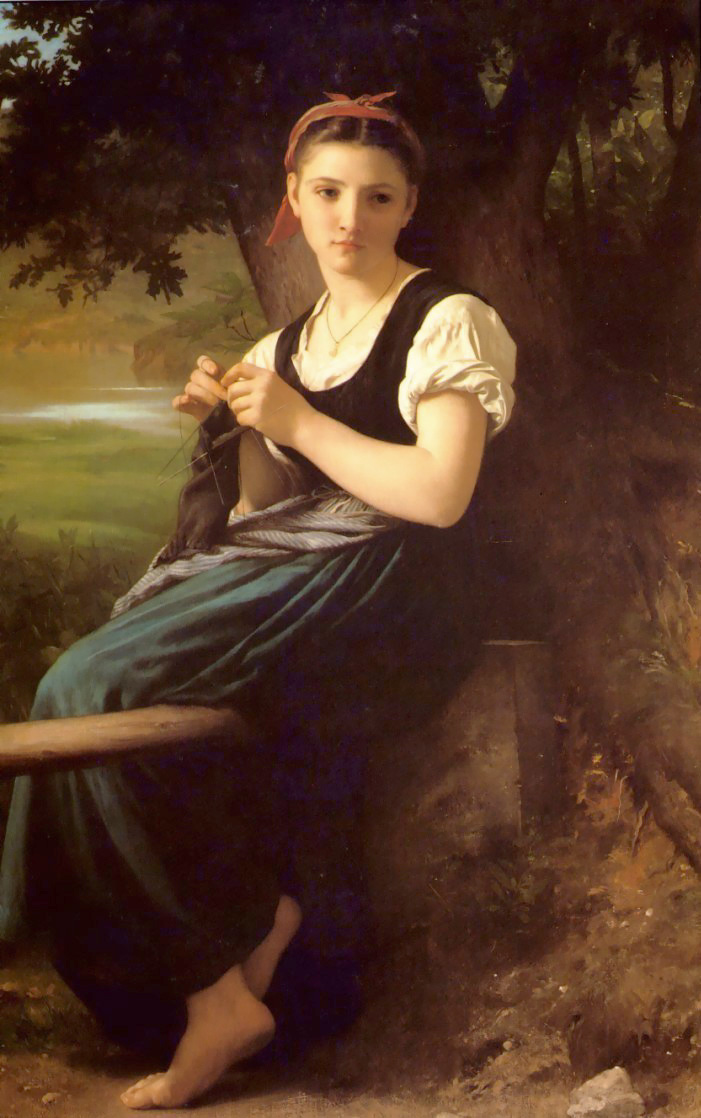
 Knitting, as defined by Wiktionary, is "Combining a piece of thread with two needles into a piece of fabric." The word is derived from knot, thought to originate from the Dutch verb knutten, which is similar to the Old English cnyttan, to knot.[1] Its origins lie in the basic human need for clothing for protection against the elements. More recently, knitting has become less a necessary skill and more a hobby.
Early origins of knitting
Knitting is a technique for producing fabric from a strand of yarn or thread. Unlike weaving knitting does not require a loom nor other large equipment, making it a valuable technique for nomadic and non-agrarian peoples.
The oldest artifact with a knitted appearance is a type of sock. It is believed that socks and stockings were the first pieces produced using techniques similar to knitting. These socks were worked in Nålebinding, a technique of making fabric by creating multiple knots or loops with a single needle and thread. Many of these existing clothing items employed nålebinding techniques; some of them look very similar to true knitting. For example, 3rd-5th century CE Romano-Egyptian toe-socks. Several pieces, done in now obscure techniques, have been mistaken for knitting or crocheting.
Most histories of knitting place its origin somewhere in the Middle East, from where it spread to Europe by Mediterranean trade routes, and then to the Americas with European colonization[2]. The earliest known examples were found in Egypt and cover a range of items, including complex colorful wool fragments and indigo blue and white cotton stockings, which have been dated between the 11th and 14th centuries CE.[3]
Early European Knitting
The earliest known knitted items in Europe were made by Muslim knitters employed by Spanish Christian royal families. Their high level of knitting skill can be seen in several items found in the tombs in the Abbey of Santa Maria la Real de Huelgas, a royal monastery, near Burgos, Spain. Among them are the knitted cushion covers and gloves found in the tomb of Prince Fernando de la Cerda, who died in 1275. The silk cushion cover was knit at approximately 20 stitches per inch. It included knit patterns reflecting the family armory, as well as the word baraka ("blessings") in Arabic in stylized Kufic script[4][5]. Numerous other knit garments and accessories, also dating from the mid-13th century, have been found in cathedral treasuries in Spain.
At this time, the purl stitch (the opposite action to the knit stitch) was unknown and purely stockinette fabric was produced by knitting in the round on multiple knitting pins. Sometimes the knitting was cut open, a process now known as steeking[citation needed].
Several paintings from Europe portray the Virgin Mary knitting and date from the 14th century, including Our Lady Knitting by Tommaso da Modena (circa 1325-1375) and Visit of the Angel, from the right wing of the Buxtehude Altar, 1400-10, by Master Bertram of Minden[6].
The first known purl stitches appear in the mid-16th century, in the red silk stockings in which Eleanora de Toledo, wife of Cosimo de Medici, was buried, and which also include the first lacy patterns made by yarn-overs[7][8], but the technique may have been developed slightly earlier. The English Queen Elizabeth I herself favored silk stockings[citation needed]; these were finer, softer, more decorative and much more expensive. Stockings that belonged to her still exist, demonstrating the high quality of the items specifically knitted for her. During this era the manufacture of stockings was of vast importance to many Britons, who knitted with fine wool and exported their wares. Knitting schools were established as a way of providing an income to the poor. The fashion of the period, requiring men to wear short trunks, made fitted stockings a fashion necessity. Stockings made in England were sent to the Netherlands, Spain, and Germany[citation needed].
Men were also the first to knit for an occupation[citation needed].
Importance in Scottish history
Knitting was such a vast occupation among those living on the Scottish Isles during the 17th and 18th centuries that whole families were involved in making sweaters, accessories, socks, stockings, etc. Fair Isle techniques were used to create elaborate colorful patterns. Sweaters were essential garments for the fishermen of these islands because the natural oils within the wool provided some element of protection against the harsh weather encountered while out fishing.
Many elaborate designs were developed, such as the cable stitch used on Aran sweaters, which was developed in the early 20th century in Ireland.
Industrial revolution
Rudimentary knitting devices had been invented prior to this period, but were one-off creations. With the advent of the Industrial Revolution, wool spinning and cloth manufacture increasingly shifted to factories. Women were employed to operate the machinery, rather than spinning and knitting items at home. The consistency of factory spun wool was better in that it was more uniform, and its weight could be gauged better as a consequence.
The city of Nottingham, particularly the district known as Lace Market, dominated the production of machine-knitted lace during the Industrial Revolution and the following decades.
1920s: the Russian Civil Wars and China
After the White Russians' defeat in the Civil War, many units retreated into China's Xinjiang and were interned there. As China was about to descend into a civil war of its own, the Russian internees were transported by camel caravans to Eastern China. According to Owen Lattimore, it was then that they passed on the art of knitting to the Chinese caravan men, who had ready supply of camel hair from their animals. In 1926, Lattimore was able to observe camel-pullers "knitting on the march; if they ran out of yarn, they would reach back to the first camel of the file they were leading, pluck a handful of hair from the neck, and roll it in their palms into the beginning of a length of yearn; a weight was attached to this, and given a twist to start it spinning, and the man went on feeding wool into the thread until he had spun enough yarn to continue his knitting". This way the camel men not only provided themselves with warm camel-hair socks, but were able to make knitwear for sale as well.[9]
1939-1945: Knitting for Victory
"Make do and mend" was the title of a booklet produced by the British wartime government department, the Ministry of Information. Wool was in very short supply, as were so many other things, and the booklet encouraged women to unpick old, unwearable, woolen items in order to re-use the wool.
Knitting patterns were issued so that people could make items for the Army and Navy to wear in winter, such as balaclavas and gloves. This not only produced the much-needed items, but also gave those on the "home front" a positive sense of contributing to the war effort.
1950s and 60s: Haute Couture
After the war years, knitting had a huge boost as greater colors and styles of yarn were introduced. Many thousands of patterns fed a market hungry for fashionable designs in bright colors. The twinset was an extremely popular combination for the home knitter. It consisted of a short-sleeved top with a long-sleeved cardigan in the same color, to be worn together.
Girls were taught to knit in school, as it was thought to be a useful skill, not just a hobby. Magazines such as "Pins and needles" in the UK carried patterns of varying difficulty including not just clothes, but also blankets, toys, bags, lace curtains and items that could be sold for profit.
1980s: A Decline
The popularity of knitting showed a sharp decline during this period in the Western world. Sales of patterns and yarns slumped, as the craft was increasingly seen as old-fashioned and children were rarely taught to knit in school.
The increased availability and low cost of machine knitted items meant that consumers could have a sweater at the same cost of purchasing the wool and pattern themselves, or often for far less.
Early 21st Century Revival
Following this decline, the 21st century has seen one of the largest resurgences of the craft in history. Natural fibers from animals, such as alpaca, angora, and merino, and plant fibers, chiefly cotton, have become easier and less costly to collect and process, and therefore more widely available. Exotic fibers, such as silk, bamboo, and qiviut, are growing in popularity as well. The yarn industry has started to make novelty yarns which produce stunning results without years of knitting experience. Designers have begun to create patterns which work up quickly on large needles, a phenomenon known as instant-gratification knitting.
Celebrities including Julia Roberts, Winona Ryder, Dakota Fanning, Cameron Diaz and Russell Crowe have been seen knitting and have helped to popularize the revival of the craft. The new millennium has also seen a return by men to the art of knitting.
As time and technology change, so does the art of knitting. The Internet allows knitters to connect, share interests and learn from each other, whether across the street or across the globe. Among the first Internet knitting phenomena was the popular KnitList with thousands of members. In 1998, the first online knitting magazine, KnitNet, began publishing. Blogging later added fuel the development of an international knitting community.
Patterns from both print and online sources have inspired groups (known as knit-a-long's, or KAL's) centered on knitting a specific pattern. Knitting podcasts, such as Cast-On and Knit Cast, have also emerged, with much cross-pollination of ideas from blogs, 'zines, and knitting books. Traditional designs and techniques that had been preserved by a relatively small number of hand-knitters are now finding a wider audience as well.
In addition, a type of graffiti called yarn bombing, has spread worldwide.
On January 14, 2006 influential author and knit-blogger Stephanie Pearl-McPhee, otherwise known as Yarn Harlot, challenged the knitting world to participate in the 2006 Knitting Olympics.[10] To participate, a knitter committed to casting-on a challenging project during the opening ceremonies of the 2006 Winter Olympics in Torino, and to have that project finished by the time the Olympic flame was extinguished sixteen days later. By the first day of the Olympics, almost 4,000 knitters had risen to the challenge.
Credits :: http://en.wikipedia.org ::


